

The Nurse Leader as Knowledge Worker
Introduction
- Nurse leaders transform evolving data-driven care (Nagle et al., 2017)
- Knowledge workers foster crucial strategic improvements
- Informatics enhancements drive improved clinical decision-making (O’Connor & LaRue, 2021)
- Leaders integrate evidence, practice, and technology
- Data shapes quality and safety initiatives
- Digital era demands continuous innovative adaptation
Welcome to today’s presentation, which will focus on the evolving role of nurse leaders as knowledge workers within the healthcare environment. We will explore how nursing informatics supports evidence-based decision-making, drives improved patient outcomes, and fosters the seamless integration of digital health technologies into everyday practice. In particular, we will highlight the essential competencies that nursing professionals must develop as healthcare continues to become more data-driven and interconnected (Kleib et al., 2021; O’Connor & LaRue, 2021).
Additionally, this presentation will connect these concepts to a practical scenario emphasizing mental health and psychiatric nursing, demonstrating how nurse leaders can leverage informatics tools and clinical judgment to address issues like medication adherence and symptom management (Semahegn et al., 2020). By understanding the intricate relationship between data, information, and knowledge, nurse leaders will be better equipped to advocate for meaningful improvements, design quality initiatives, and ensure that their teams deliver patient-centered, evidence-informed care that aligns with organizational goals (Nagle et al., 2017).
Knowledge Worker
- Knowledge workers interpret complex health data (Sweeney, 2017)
- They effectively synthesize evidence into practice
- Continuous learning refines their evolving expertise
- Adaptive thinking continually drives innovative solutions
- Integrating technologies enhances clinical care judgments
- Data-informed decisions improve patient health outcomes
A knowledge worker in healthcare is someone who applies specialized expertise, critical thinking, and analytic skills to transform data into actionable insights. These professionals, which often include nurse leaders, draw upon clinical experience, research findings, and patient feedback to navigate complex healthcare environments. By synthesizing a broad range of information sources, knowledge workers help ensure that patient care decisions are informed, timely, and evidence-based (Sweeney, 2017).
Furthermore, knowledge workers must continuously adapt as health technologies evolve. They integrate electronic health records (EHRs), mobile apps, and clinical decision support systems into their workflows, ensuring that the resulting insights improve patient safety, quality, and outcomes. Moreover, these individuals do not merely collect or manage data; rather, they interpret patterns, identify trends, and propose innovative solutions that ultimately elevate healthcare delivery. Thus, as the healthcare landscape becomes increasingly data-driven, knowledge workers play a pivotal role in aligning clinical practice with emerging digital health capabilities (Kleib et al., 2022).
Nursing Informatics and Nurse Leader as Knowledge Worker
- Nursing informatics integrates science, care technology (Nagle et al., 2017)
- Leaders convert data into actionable knowledge (O’Connor & LaRue, 2021)
- They diligently guide evidence-based clinical decisions
- Seamlessly integrating systems enhances patient safety
- Informatics competencies continually refine nursing practice
- Adaptation ensures sustained comprehensive healthcare improvements
Nursing informatics is the integration of nursing science with information and communication technologies to optimize health outcomes, streamline clinical workflows, and advance nursing practice. It involves the design, implementation, and evaluation of innovative systems that allow nurses to efficiently document care, access patient records, and apply evidence-based guidelines (Nagle et al., 2017). By combining clinical expertise with informatics competencies, nurse leaders can serve as pivotal knowledge workers who bridge the gap between frontline staff, data systems, and organizational goals The Nurse Leader as Knowledge Worker.
As knowledge workers, nurse leaders leverage electronic health records, decision support tools, and analytics platforms to identify trends, anticipate patient needs, and guide teams toward strategic improvements. Additionally, they use their clinical reasoning to transform raw data into meaningful knowledge, ensuring that informatics efforts translate into measurable advances in patient safety, quality, and satisfaction (O’Connor & LaRue, 2021). In this way, nurse leaders as knowledge workers champion both technological innovation and human-centered care in the digital era.
Nurse Leader as Knowledge Worker
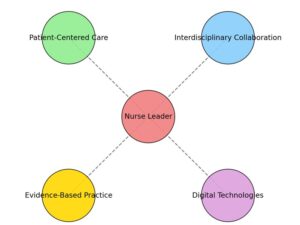
The visual on this slide illustrates the nurse leader as a central figure connecting multiple domains: patient-centered care, interdisciplinary collaboration, evidence-based practice, and digital technologies. For example, you might see an image depicting a nurse leader gathering data from EHRs, communicating with care teams, and interpreting real-time patient metrics to guide decisions. This conceptual model highlights how a nurse leader continually transforms data into knowledge while maintaining a patient-focused perspective.
Furthermore, the diagram shows how nurse leaders bridge the gap between the clinical setting and informatics teams, ensuring that technological tools align with bedside practice needs. By integrating feedback loops—where patient outcomes inform future interventions—they create a dynamic environment of continuous improvement (Kleib et al., 2021). Additionally, they facilitate education and training for staff, helping frontline nurses acquire the informatics competencies needed for modern practice (Nagle et al., 2017). Ultimately, this representation underscores the multifaceted role of nurse leaders as informed, adaptable, and patient-advocating knowledge workers.
Hypothetical Scenario Application
- Medication adherence crucial in bipolar management (Semahegn et al., 2020)
- Analyzing data reveals hidden nonadherence patterns
- Side effects often reduce treatment compliance
- Tailored interventions ultimately improve patient engagement
- Informed decisions continuously adjust care plans
- Leaders advocate meaningful ongoing quality improvements
In my hypothetical scenario, a mental health and psychiatric nursing unit grapples with managing medication adherence for patients diagnosed with bipolar disorder. Such patients, when nonadherent, may experience exacerbated symptoms, increased hospitalizations, and diminished quality of life (Semahegn et al., 2020). To address this challenge, a nurse leader acting as a knowledge worker could harness existing digital health tools—such as EHR data on refill histories, patient self-reports via smartphone apps, and documented side effect occurrences—to identify patterns of nonadherence.
These data could be accessed through secure clinical databases and patient engagement platforms. The nurse leader might analyze trends to determine if specific medications correlate with higher nonadherence due to intolerable side effects, thereby guiding decisions for medication adjustments or targeted patient education. Ultimately, clinical reasoning and judgment transform these data points into actionable knowledge. As colleagues suggested, integrating multidisciplinary feedback ensures that outcomes inform strategic care planning, promoting a culture of continuous improvement and patient empowerment.
Conclusion
- Nurse leaders unite data, technology, patient care.
- Continuous adaptation steadily refines informatics competencies
- Data-driven strategies effectively improve patient outcomes
- Evidence-based decisions significantly strengthen health systems
- Nurse leaders champion future healthcare innovations
- Collaboration ensures sustained organizational success globally
In conclusion, nurse leaders as knowledge workers are uniquely positioned to bridge clinical practice and digital innovation within healthcare. By leveraging nursing informatics tools, they expertly translate raw data into actionable insights, leading teams toward enhanced patient safety, improved outcomes, and more efficient care delivery. Additionally, their ability to anticipate future needs, adapt to emerging technologies, and uphold evidence-based standards ensures that their organizations remain agile and responsive.
The mental health scenario exemplifies how these principles apply in practice: nurse leaders inform decisions about medication adherence, symptom tracking, and treatment adjustments, ultimately improving patient well-being. As we move further into a digital era, the role of nurse leaders as knowledge workers will continue to expand. By continually refining their informatics competencies and fostering a culture of collaboration, they will ensure that healthcare remains compassionate, patient-centered, and aligned with the highest quality standards
References
Kleib, M., Chauvette, A., Furlong, K., Nagle, L., Slater, L., & McCloskey, R. (2021). Approaches for defining and assessing nursing informatics competencies: a scoping review. JBI Evidence Synthesis, 19(4), 794-841. https://doi.org/10.11124/jbies-20-00100
Kleib, M., Nagle, L. M., Furlong, K. E., Paul, P., Wisnesky, U. D., & Ali, S. (2022). Are future nurses ready for digital health? Informatics competency baseline assessment. Nurse Educator, 47(5), E98-E104. https://doi.org/10.1097/nne.0000000000001199
Nagle, L., Sermeus, W., & Junger, A. (2017). Evolving Role of the Nursing Informatics Specialist. In J. Murphy, W. Goosen, & P. Weber (Eds.), Forecasting Competencies for Nurses in the Future of Connected Health (212-221). Clifton, VA: IMIA and IOS Press. Retrieved from https://serval.unil.ch/resource/serval:BIB_4A0FEA56B8CB.P001/REF
O’Connor, S., & LaRue, E. (2021). Integrating informatics into undergraduate nursing education: A case study using a spiral learning approach. Nurse Education in Practice, 50, 102934. https://doi.org/10.1016/j.nepr.2020.102934
Semahegn, A., Torpey, K., Manu, A., Assefa, N., Tesfaye, G., & Ankomah, A. (2020). Psychotropic medication non-adherence and its associated factors among patients with major psychiatric disorders: a systematic review and meta-analysis. Systematic reviews, 9, 1-18. https://doi.org/10.1186/s13643-020-1274-3
Sweeney, J. (2017). Healthcare Informatics. Online Journal of Nursing Informatics, 21(1). https://eds.p.ebscohost.com/eds/detail/detail?vid=0&sid=24486a20-534c-4aed-9f34-6b6b0125f73a%40redis&bdata=JkF1dGhUeXBlPXNoaWImc2l0ZT1lZHMtbGl2ZSZzY29wZT1zaXRl#AN=128848047&db=rzh
The Nurse Leader as Knowledge Worker Assignment Instructions
The term “knowledge worker” was first coined by management consultant and author Peter Drucker in his book, The Landmarks of Tomorrow (1959). Drucker defined knowledge workers as high-level workers who apply theoretical and analytical knowledge, acquired through formal training, to develop products and services. Does this sound familiar?
Nurses are very much knowledge workers. What has changed since Drucker’s time are the ways that knowledge can be acquired. The volume of data that can now be generated and the tools used to access this data have evolved significantly in recent years and helped healthcare professionals (among many others) to assume the role of knowledge worker in new and powerful ways.
In this Assignment, you will consider the evolving role of the nurse leader and how this evolution has led nurse leaders to assume the role of knowledge worker. You will prepare a PowerPoint presentation with an infographic (graphic that visually represents information, data, or knowledge. Infographics are intended to present information quickly and clearly.) to educate others on the role of nurse as knowledge worker.
Reference: Drucker, P. (1959). The landmarks of tomorrow. New York, NY: HarperCollins Publishers.
Resources

Be sure to review the Learning Resources before completing this activity.
Click the weekly resources link to access the resources.
To Prepare:
- Review the concepts of informatics as presented in the Resources.
- Reflect on the role of a nurse leader as a knowledge worker.
- Consider how knowledge may be informed by data that is collected/accessed.
The Assignment:
- Explain the concept of a knowledge worker.
- Define and explain nursing informatics and highlight the role of a nurse leader as a knowledge worker.
- Include one slide that visually represents the role of a nurse leader as knowledge worker.
- Your PowerPoint should Include the hypothetical scenario you originally shared in the Discussion Forum. Include your examination of the data that you could use, how the data might be accessed/collected, and what knowledge might be derived from that data. Be sure to incorporate feedback received from your colleagues’ responses.
By Day 7 of Week 2
Submit your completed Presentation.
submission information
Before submitting your final assignment, you can check your draft for authenticity. To check your draft, access the Turnitin Drafts from the Start Here area.
- To submit your completed assignment, save your Assignment as WK2Assgn_LastName_Firstinitial
- Then, click on Start Assignment near the top of the page.
- Next, click on Upload File and select Submit Assignment for review.

Rubric
| Criteria | Ratings | Pts |
|---|---|---|
|
Develop a 5- to 6-slide PowerPoint presentation that addresses the following:· Explain the concept of a knowledge worker.· Define and explain nursing informatics. |
||
|
Develop a graphic visual representation of the role of the nurse leader as a knowledge worker The Nurse Leader as Knowledge Worker. On the slide, include an explanation of the role. |
||
|
Present the hypothetical scenario you originally shared in the Discussion Forum. Include your examination of the data you could use, how the data might be accessed/collected, and what knowledge might be derived from the data. Be sure to incorporate feedback received from your colleagues’ replies. |
||
|
PowerPoint presentation:The presentation is professional; images are appropriately attributed; images are clear. The presentation text is readable. Presentation flows well and is presented in a logical order. |
||
|
Resources |
||
|
Written Expression and Formatting – English writing standards:Correct grammar, mechanics, and proper punctuation |
||
|
Written Expression and Formatting – APA:The reference list and image attribution list follow correct APA format |